19th July: Big changes for circular fashion!
As of the 19th July, companies can no longer burn or landfill unsold items and must design for better durability, repairability, and recyclability.
Yes, you heard that right. Approximately 4-9% of unsold garments are currently being destroyed (1). Zoom out further and the EU throws away around 60 million tonnes of food a year (2). A huge waste!
These changes are part of the Ecodesign for Sustainable Products Regulations (ESPR). For the fashion industry, these changes aim to combat overproduction and the throw-away culture that dictates much of society.
In parallel, the EU is also laying the groundwork for the Digital Product Passport (DPP): a standardised way to make product data available to anyone who scans a unique code. Its rollout will be staggered, dependent on product category.
These regulations are a great step for the circular economy, and similar policies have already been tried, tested, and proven to work around the world:
- France already introduced similar rules back in 2020, and it's working with the launch of the repairability index.
- Germany and Lithuania show deposit return schemes deliver at scale.
- Chile has made producers financially responsible for recycling packaging, tyres, batteries, and electronics since 2023.
All of which is evidence that circular economy policy can move from paper to practice, and get real results.
And the wider market is responding too: the European remanufacturing market alone is projected to grow from €31 billion to €100 billion by 2030, creating an estimated 500,000 jobs (3).
So, what are the positives:
- The ESPR is a BIG step for circularity. Regulation is one of the strongest levers for pushing industries toward more sustainable practice, faster than voluntary commitments ever could.
- Once live, repair and recycling instructions will be available to anyone who scans the data carrier, a genuine win for consumers trying to make circular choices.
- It's not just an environmental story. EU ecodesign and labelling measures are estimated to have already saved 10% of the EU's primary energy consumption in 2020 (4).
But there are also a few critical reflections. We've looked at what our expert network is saying and summarised the following:
- Questions remain about how to track and verify authenticity (France's own repairability index ran into exactly this problem).
- Online retail's high return rate is a real pressure point: roughly a fifth of clothing purchased online gets returned, and about a third of that is ultimately destroyed (1).
- Some worry these rules quietly favour recyclability metrics over genuinely novel biomaterials, since recyclability is easier to standardise and score.
We are of course encouraged by these regulatory shifts. Circularity is how we can consume sustainably and ultimately help combat the climate crisis. But rules only set the floor. Consumer values and investment in the development of sustainable alternatives are the other half of the puzzle.
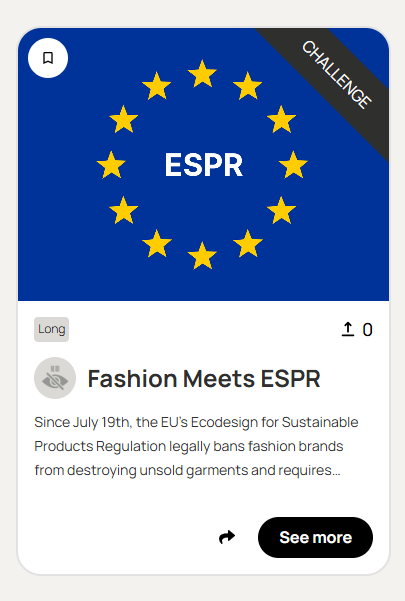
A puzzle, might we add, that ReDo is working hard to tackle. Got ideas or resources that could help businesses comply with these new requirements? Join our live ESPR challenge on the ReDo platform:
Further resources:
 Lidia Lüttin
Appendix:

2.
 Eurostat
3.
 Rebecca Christie, Heather Grabbe, Luca Léry Moffat and Janez Potočnik
4.