One Industry's Waste, Another's Resource
The circular economy could halve industrial CO₂ emissions by 2050. HALF! And yet most companies still treat waste as a cost, not a resource.
Introducing Industrial Symbiosis; One potential answer to the monumental issue that is resource inefficiency and wastage. At its core, it is the practice of turning one company's waste into another's raw material, building local networks that replace the linear systems governing how most resources are consumed and discarded.
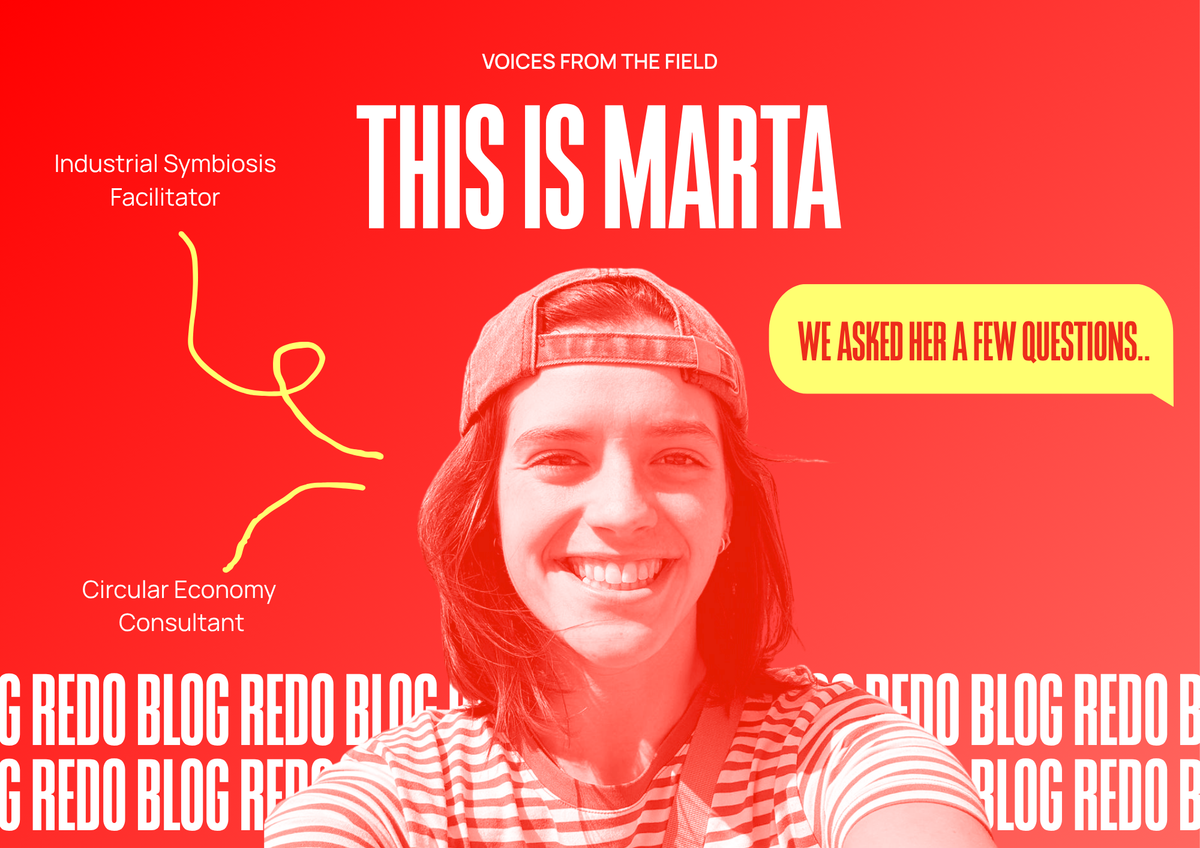
To speak on this is Marta, who is a consultant with deep roots in the field. After completing her Masters degree in Global Development in Copenhagen, Marta then went on to support the first industrial symbiosis project of its kind in Livorno, Italy.
To keep things relatively short and sweet, we asked Marta three questions to give an insight into her line of work.
1. What’s the most overlooked detail in making a product or system truly circular?
I believe the most overlooked aspect is the importance of people and networks. Working with waste streams and industrial by-products is not easy. You can develop the most advanced technologies and digital platforms, but in the end, solutions are found by talking to people. Truly circular systems are built through collaboration with passionate, skilled individuals who are willing to tackle complex challenges and see sustainability not as a constraint, but as a driver for innovation and problem-solving.
2. What’s one thing you wish more people understood about your field?
I wish more people understood that the circular economy is not simply about sustainability; it is an industrial strategy for sustainable development. At its core, it is industrial symbiosis: reusing scarce resources, strengthening local supply chains, and making territories less dependent on imports while creating public-private collaborations. Circularity means reducing both resource and disposal costs, accessing European funding for implementation, and building stronger local value chains. When companies are locally resilient in terms of resources, they are less vulnerable to geopolitical crises and market disruptions.
3. What’s the most exciting “what if” question guiding your work right now?
My guiding question is: What if industrial symbiosis were implemented everywhere? Today, water and energy can already be shared locally in economically viable ways, particularly within industrial parks and clusters. But materials, especially those with high value, could also be exchanged across regions or even across national borders. I find this vision exciting: a world where industrial ecosystems are interconnected and resources continuously circulate at both local and larger scales.
For further Resources on Marta's work, check out the following:
Masters Thesis: Link
Linkedin Newsletter: Link
The Livorno Project: Link
Stay tuned for our next blog on all the wonderful topics related to Circularity, which is what we are all about at ReDo.